Marigolds
The Bluest EyeMarigolds are the novel’s central image of hope attempted in a world that will not sustain it. Claudia and Frieda plant seeds believing their growth might help make everything right, but the flowers shrivel and die alongside Pecola’s baby. The image’s decisive force lies in the sisters’ later recognition that the failure was not simply their fault: the earth itself was unyielding.
The Failed Planting
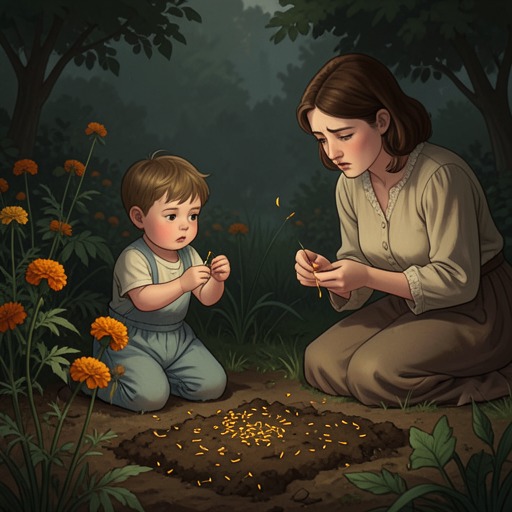
The sisters connect the absent flowers to the events of fall 1941. They had believed that the marigolds’ failure to grow was because Pecola was carrying her father’s child. Their attention was fixed on the health and safe delivery of the baby, and the flowerless earth seemed to register the same crisis that occupied them.
Their response was an act of childhood faith. They planted seeds and said the right words over them, imagining that if the flowers blossomed, everything would be all right. The ritual gives the marigolds a practical as well as symbolic role: the sisters try to intervene in a frightening reality through the one small action available to them, turning planting into a wager on life and repair.
Blame and Recognition
For years, Claudia believes her sister was right to blame her: she had planted the seeds too far down in the earth. That explanation assigns the failed flowers to a correctable mistake by a child. Only later do the sisters understand the possibility they had not considered at the time—that the soil itself might have been unyielding.
The correction does not erase their guilt or restore the flowers. It changes the scale at which failure can be understood. Their small plot of black dirt and the plot into which Pecola’s father dropped his seeds are placed beside one another, joining innocent effort to lust and despair. The comparison does not make these acts equivalent; it sets their radically different intentions against a shared image of seeds meeting earth that will not yield.
Loss and the Novel’s Ending
The final accounting gathers the seeds and the baby into a single devastating parallel: the seeds shriveled and died, and the baby died too. The marigolds do not offer a consoling promise that innocence or hope will be rewarded. Their failure instead makes the loss visible and makes the sisters confront the limits of their childish attempt to change what was happening to Pecola.
The narration widens from that failed plot to what remains: Pecola and the unyielding earth. Cholly is dead, and the narrator identifies the loss of childhood innocence alongside his death. In this ending, the flowers’ failure is not an isolated disappointment but part of a landscape of grief. The empty ground holds together the sisters’ remembered hope, the baby’s death, and the consequences of adult actions.
Image, Responsibility, and Explanation
The marigolds’ meaning develops through delayed recognition. At first, Claudia and Frieda interpret the failure through the immediate crisis of Pecola’s pregnancy and their belief in the power of planting and spoken words. Later, Claudia recalls her own blame and revises it by recognizing the earth’s unyielding character. The movement from self-accusation to a larger account of conditions does not supply an easy remedy; the seeds remain dead.
That recognition also shapes the novel’s final turn toward explanation. Faced with what remains of hope, fear, lust, love, and grief, the narrator says there is little left to say except why, then acknowledges the difficulty of handling that question and takes refuge in how. The marigolds belong to this shift: they do not solve the causes of the tragedy, but their failed growth gives its consequences a concrete form. Their barren plot becomes an image of the distance between hoping for life and living in conditions that will not nourish it.